
How Tsinghua’s Chemistry Wizards Are “Building” Proteins Like LEGO Blocks
Published:
🎯 The Big Reveal Up Front: Chemistry Just Leveled Up!
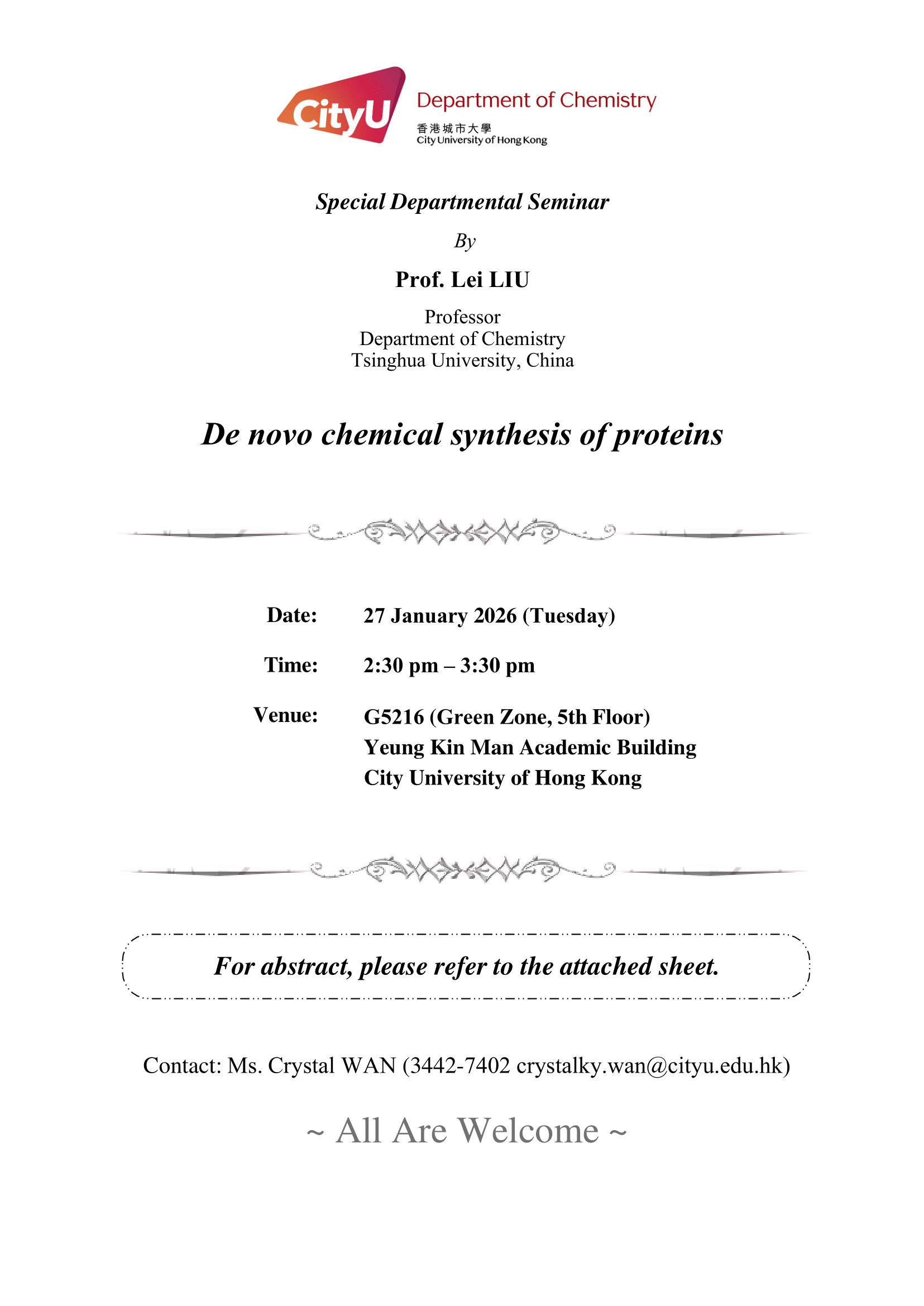
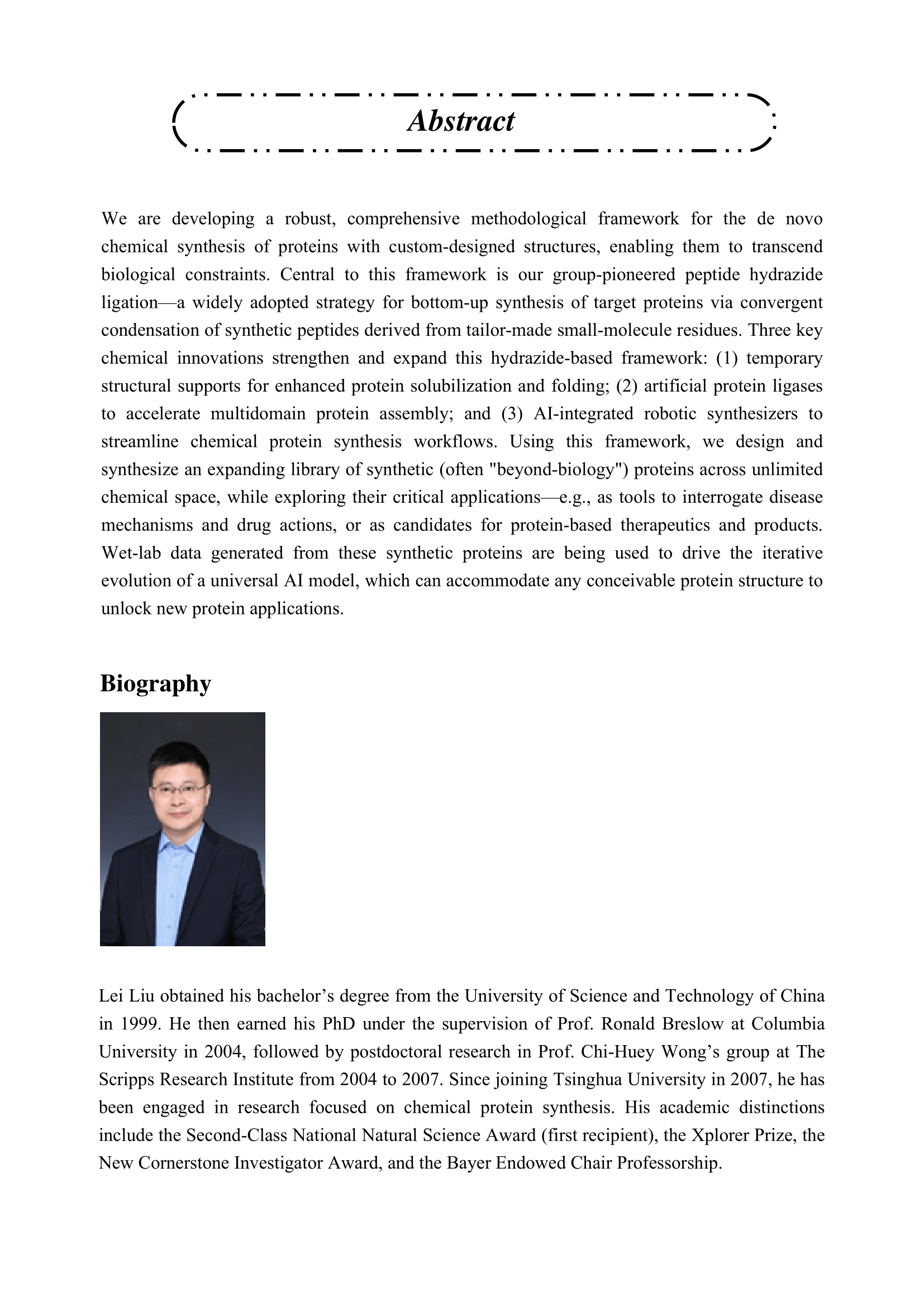
Professor Liu Lei hosted a seminar on de novo chemical protein synthesis at City University of Hong Kong. His lab at Tsinghua University has developed a comprehensive methodological framework that transcends biological constraints, enabling synthesis of custom-designed proteins up to 3,000 amino acids—covering 99.7% of all natural proteins. Three key innovations form this framework: (1) peptide hydrazide ligation for convergent synthesis without protecting groups; (2) reversible auxiliary strategies using charged or carbohydrate tags to prevent aggregation during synthesis; and (3) artificial ligase enzymes that catalyze protein assembly in denaturing conditions. These techniques unlock “beyond-biology” applications including mirror-image D-proteins, site-specifically modified therapeutic targets, and rapid drug candidate synthesis. This post explores the chemistry breakthroughs, pharmaceutical implications, and synergies with AI-driven drug discovery that make chemical protein synthesis a game-changer for biomedical research.
Today I attended a lecture by Professor Liu Lei from Tsinghua University at City University of Hong Kong, and honestly, my mind is blown! 🤯 I thought proteins could only be made by cells, but Professor Liu’s team just proved that chemists can build any protein from scratch—even ones nature has never seen before.
The three game-changing breakthroughs:
- Peptide Hydrazide Ligation (Join protein pieces without the usual chemical headaches)
- Reversible Auxiliary Strategies (Temporary “scaffolding” keeps proteins from clumping during synthesis)
- Artificial Ligase Enzymes (Designer enzymes that work where natural ones fail)
It felt like watching someone unlock a secret level in protein synthesis—going from “we can make small peptides” to “we can build 99.7% of all known proteins.” 🧬✨
📚 The Chemistry Revolution: Breaking the Rules We Thought Were Unbreakable
1. Peptide Hydrazide Ligation | The “Impossible” Reaction 🔗
Core Breakthrough: Two Nucleophiles Can Form an Amide Bond
Professor Liu started by challenging organic chemistry dogma. For decades, everyone “knew” you need an electrophile + nucleophile to make peptide bonds. But his team asked: what if we use two nucleophiles instead?
Traditional methods had three fatal flaws:
- Racemization: Your protein becomes a mixture of wrong stereoisomers
- Hydrolysis: Water destroys your precious intermediate
- Self-destruction: Protein electrophiles react with themselves, creating a purification nightmare
The elegant solution? Peptide hydrazide chemistry:
- Start with a peptide ending in -NHNH₂ (hydrazide)
- Add sodium nitrite (pH 2-3)—yes, the same stuff used in food preservation
- Add a cysteine-containing peptide (pH 7)
- Boom—you get a new amide bond with zero protecting groups needed
What does this unlock?
- 🧪 Commercially available building blocks: You can literally buy 20-60 amino acid segments with hydrazides pre-installed
- 🚀 One-pot synthesis: Add segments sequentially without purifying intermediates
- 🎯 Any amino acid works: Natural, unnatural, D-amino acids, β-amino acids—total design freedom
The most surprising part? The intermediate—acyl azide—was supposed to undergo Curtius rearrangement (that’s textbook organic chemistry). But in the presence of thiols, it converts to thioesters faster than the rearrangement can happen. Even reviewers initially didn’t believe this!
It’s like discovering that water can flow uphill under the right conditions—chemistry just doesn’t work the way we thought.
2. Reversible Auxiliary Strategies | The “Scaffolding” Trick 🏗️
Core Innovation: Temporary Helpers Prevent Disaster
Once you get past 300 amino acids, a new enemy appears: protein aggregation. Professor Liu explained this with a brilliant analogy:
Think of building a skyscraper. Ancient builders could only make small structures because they lacked scaffolding. Modern engineers use temporary supports during construction, then remove them once the building stands on its own.
Here’s the molecular problem:
- Small proteins (<100 amino acids): Hydrophobic residues mostly face outward → soluble during synthesis
- Large proteins (>300 amino acids): Many hydrophobic residues buried inside → insoluble intermediates that crash out of solution like “gel-like solids”
The solution comes in two versions:
| Strategy | How It Works | Best For |
|---|---|---|
| Version 1.0: Positive Charges | Attach arginine-rich tags via cleavable linkers | Proteins without excessive negative charges |
| Version 2.0: Carbohydrates | Install neutral sugar groups (glucose, lactose, etc.) | Proteins that resist Version 1.0; also assists folding! |
The carbohydrate strategy had an unexpected bonus: Interleukin-5, a protein that nobody could refold in vitro before, folded with ~100% efficiency when temporarily glycosylated. The sugars acted like molecular chaperones!
With these strategies, the synthesis ceiling jumped from 300 → 600 amino acids, covering 87% of all natural proteins.
3. Template-Driven Ligation & Artificial Ligases | Conquering the Final Frontier 🧬
Core Problem: When Proteins Get Too Big to React
At 600+ amino acids, chemistry hits another wall. But this time, it’s not a solubility problem—it’s a conformational problem.
Here’s the physics:
- Small peptides: The reactive N- and C-termini are always exposed to solution → fast reactions
- Giant proteins: The chain folds back on itself, burying the reactive sites → effective concentration drops to nearly zero
Professor Liu described this as “soluble but unreactive”. Students would report: “The reaction just doesn’t happen, even though everything’s dissolved.”
The paradigm shift: Stop relying on random collisions. Use template-driven catalysis.
Three approaches emerged:
- Split Intein Templates (BISIAL): Natural protein-recognition domains bring the termini together, even in 6 M urea
- Thioacetal Chemistry (TAL): Chemical templates using aldehyde-thiol coupling—works even in harsh trifluoroacetic acid
- Artificial Ligase Enzymes: The ultimate solution—evolved enzymes that work in denaturing conditions
The artificial ligase (Mutant-51, developed through directed evolution) is genuinely impressive:
- 92% conversion in 4 M urea (natural enzymes would be completely denatured)
- Works at ultra-low concentrations (0.5 µM to 100 µM)
- Joins 50+ kDa segments to create >100 kDa proteins
With this technology, they’ve now synthesized:
- Taq DNA polymerase: 856 amino acids, fully functional
- UFD2: 2,824 amino acids—nearly 3,000!
The new ceiling: 3,000 amino acids → 99.7% of all proteins.
💡 The Bigger Picture: Why This Matters Beyond Academic Curiosity
1. Expanding Nature’s Playbook 🌌
Professor Liu invoked R.B. Woodward’s philosophy: “Organic chemistry has literally placed a new nature beside the old.”
Biological expression is limited to 20 canonical amino acids. Chemical synthesis unlocks:
- Mirror-image proteins (made from D-amino acids—completely resistant to biological degradation)
- Cyclic proteins (no loose ends, ultra-stable)
- Unnatural backbones (β-amino acids, exotic modifications)
This isn’t just about copying nature—it’s about creating molecular structures that evolution never explored.
2. Precision Medicine Through Proteoform Engineering 🏥
Here’s where it gets medically exciting. The same gene can produce dozens of different protein versions (proteoforms) through post-translational modifications:
- Methylation
- Phosphorylation
- Ubiquitination
- Glycosylation
Most diseases involve specific modified versions, not just “too much” or “too little” protein.
The challenge: You can’t study what you can’t make. Cells produce mixtures; chemical synthesis gives you exactly the modified form you need.
Breakthrough application: Molecular Glue Degraders
Professor Liu’s team synthesized 366-amino-acid protein complexes that trap the transient intermediates of ubiquitination. This is like freezing a hummingbird mid-flight—these enzyme-substrate complexes exist for milliseconds before dissociating.
Using these synthetic tools, they:
- Solved structures of 8 different molecular glue drugs (3 already approved: thalidomide, lenalidomide, pomalidomide)
- Explained why mezigdomide selectively degrades IKZF1/3 while eragidomide targets GSPT1, despite near-identical structures
- Discovered that a single side-chain difference determines whether a drug enters the “right” binding pocket
Real-world impact:
- Tirzepatide (Eli Lilly’s blockbuster GLP-1/GIP dual agonist): Predicted $50 billion revenue in 2026—developed using hydrazide chemistry for rapid analog synthesis
- Two molecules in Phase II clinical trials, including DSS1 for dry eye syndrome
3. The AI Revolution Needs Chemistry 🤖
Here’s the most exciting synergy: Professor Liu collaborated with Tsinghua’s AI center to develop DrugCLIP—an algorithm that screens 500 million molecules against human proteins.
The workflow:
- Chemical synthesis provides precise protein structures (including pockets never seen before)
- AI identifies which molecules from enormous databases might bind
- Synthetic chemistry rapidly tests predictions
- Success rate: ~15% hit at 10 µM potency for the free version
They discovered TRIP12 ubiquitin ligase inhibitors without any experimental screening—just computational prediction validated by synthesis. Two compounds showed Kd values around 10-12 µM.
AI designs. Chemistry delivers. Together they unlock “unlimited structural space”.
4. Speed as a Strategic Advantage ⚡
In pharmaceutical development, time = billions of dollars.
| Method | Time Required |
|---|---|
| Chemical synthesis | Few days |
| Biological expression | Weeks |
For a company racing to file patents or enter clinical trials, hydrazide chemistry isn’t just faster—it’s the difference between winning and losing a market.
🤔 Questions That Linger (and Future Brainstorming)
The seminar sparked several thoughts for neuroscience work:
For Alzheimer’s Research:
- Could you synthesize site-specifically modified tau or amyloid-beta oligomers to study exactly which modifications drive toxicity?
- Professor Liu mentioned Professor Chong Liu at Shanghai Institute of Organic Chemistry does extensive work on misfolding inhibitors using hydrazide ligation
For Screening Campaigns:
- Synthetic alpha-synuclein with precise phosphorylation patterns (e.g., pS129) would be invaluable for high-throughput screening of aggregation inhibitors
Methodological Questions:
- Can molecular chaperones (like GroEL) assist folding of chemically synthesized proteins? Answer: Yes! Even D-amino acid proteins fold with GroEL assistance
- Could you couple chemical synthesis with computational models to validate predicted biomarker structures?
🎤 Final Thoughts: The Philosophy of “Building” vs. “Growing”
My biggest takeaway: The most powerful innovations come from questioning assumptions everyone else accepts.
For 120+ years (since Emil Fischer in the 1900s), protein chemistry assumed:
- You need electrophiles to make amide bonds → Wrong
- Proteins >300 amino acids need protecting groups → Wrong (just use auxiliaries)
- Natural enzymes can’t work in denaturing conditions → Wrong (evolve artificial ones)
Professor Liu’s research embodies what R.B. Woodward called “placing a new nature beside the old”. We’re no longer limited to the proteins that ribosomes can make. We can design molecules that:
- Resist degradation (D-proteins)
- Target diseases with atomic precision (site-specific modifications)
- Function in ways evolution never imagined (unnatural backbones)
This isn’t just chemistry—it’s molecular architecture.
This article is for you if:
🧬 You think “you can only make what biology allows” and want to see those limits shattered
💊 You’re interested in next-generation therapeutics based on precise protein engineering
🤖 You want to understand how AI + chemistry creates a feedback loop for drug discovery
🔬 You believe understanding disease mechanisms requires tools biology can’t provide
Let’s discuss: If you could chemically synthesize any modified protein for your research, what would it be? For me—site-specifically phosphorylated alpha-synuclein to map exactly which modifications trigger Parkinson’s pathology. What’s yours? 💭
P.S. The seminar Q&A revealed something beautiful: Professor Liu admitted they didn’t predict all these challenges upfront. They hit the 300-amino-acid wall, developed auxiliaries, then hit the 600-amino-acid wall, realized it was conformational, then developed templates. Great science isn’t about having all the answers—it’s about having the persistence to solve each problem as it emerges. That’s real research wisdom. 🙏
Seminar Details:
- Speaker: Professor Lei Liu, Department of Chemistry, Tsinghua University
- Title: De novo chemical synthesis of proteins
- Date: January 27, 2026
- Venue: G5216 (Green Zone, 5th Floor), Yeung Kin Man Academic Building, City University of Hong Kong